Product Overview
A stainless steel pipe with no welded joint begins as a solid round billet. The billet is pierced, then hot rolled or cold drawn into a hollow section, so the finished wall is one continuous piece of steel from end to end with no weld anywhere along its length. That is the heart of the product: no seam, no weld bead and no heat-affected zone interrupting the wall, which is why it is specified wherever a line has to hold pressure, run hot, or survive being cycled.
We produce the range in grades 201, 304, 316, 430 and 2205, in the diameters and walls set out in the specification below, cut to the length you order. Ends are plain cut, ready for butt welding, threading or a mechanical joint, and both ends are capped so the bore arrives clean.
Most orders come from distributors and stockists holding stock for resale, from fabricators building spools and skids, and from project teams buying against a written specification. From Shanghai we ship as a stainless steel pipe supplier to wholesalers and project buyers across Southeast Asia, the Middle East, South Asia and West Asia, quoting from the grade, size and quantity you actually need.
A stainless steel pipe with no welded joint starts as a pierced billet that is then hot rolled or cold drawn until the wall reaches the ordered thickness. Nothing is welded along its length, so the section stays uniform, the grain structure stays consistent and there is no longitudinal joint to account for. That matters most under internal pressure. Hoop stress is carried by the wall, and a wall with no welded joint carries it evenly the whole way round. There is no weld reinforcement to blend back, no undercut at a weld toe and no hardness change beside a fusion line — three of the places where a welded tube tends to fail first. The same logic applies when the line is cycled: pressure swings and repeated heating and cooling concentrate stress at a seam, and a body with no welded joint has no seam to concentrate it on. It also holds up better than a threaded joint in vibrating service. Where threads are used at all they sit at the ends, so the pipe body itself has no thread roots cut into the wall to act as stress raisers. On site, a round pipe with a consistent outside diameter is quicker to place. It slides through supports, guides and sleeves without snagging and lines up with the fitting or flange at the far end without being forced. Straightness and roundness are part of what the order is buying, and they are what the dimensional check at the end of the line verifies. The result suits severe service — high pressure, high temperature, thermal cycling and aggressive process fluid — with no part of the wall left as the weak link.
Inspection and Documentation
The pipe is inspected before it is packed, not after it lands. Positive material identification checks the alloy of the actual pipe against the grade on the order, so a mixed bundle cannot slip through. A hydrostatic test confirms the wall holds pressure with no leak and no permanent set. Eddy current testing scans the length for surface and near-surface defects, ultrasonic testing looks through the wall for internal flaws and thickness variation, and a dimensional check closes the loop on outside diameter, wall and length. A material test certificate is issued with the lot.
That file is the part of the order your own customer will ask for — the distributor reselling the pipe, the fabricator building a pressure spool, the inspector signing off an installation. Ask for it by grade and heat number when you place the order so it is prepared with the shipment rather than chased afterwards. As a stainless steel pipe supplier we keep the test records tied to the heat number, which means a traceability question gets answered from a file instead of from memory.
Outside Diameter and Wall Thickness
- Outside diameter is the number that governs the order. Pipe is bought and sold on outside diameter and wall thickness, not on the nominal bore stamped on an old fitting. If you are replacing a line, measure the OD across the pipe and check it against the drawing before you quote.
- The wall can be quoted two ways. In millimetres straight off the drawing, or as a schedule. Our reference chart runs from SCH 5S to SCH 80S, and once the OD is fixed the two describe the same thing. A stainless steel pipe ordered by schedule is simply a wall expressed in shorthand.
- A higher schedule means a heavier wall at the same OD. If a line was designed around a schedule 80 steel pipe, dropping to a lighter schedule to make it fit changes the pressure capability of the whole run. Quote the schedule, not the nearest millimetre.
- Measure in four places. Wall thickness varies slightly around the circumference and along the length; a caliper or ultrasonic gauge read at the 12, 3, 6 and 9 o'clock positions tells you whether the pipe matches the drawing.
- Tolerance is part of the specification. Standard mill tolerances on OD and wall apply unless a tighter one is agreed, so state it on the enquiry if your design calculation depends on minimum wall.
- Wall carries the pressure, grade carries the corrosion life. A thicker wall in a lower grade and a thinner wall in a higher grade are two different decisions, and settling the grade first usually makes the wall obvious.
- Match the fittings to the same schedule. Elbows, tees and reducers are stainless steel pipe fittings, and they are ordered by OD and wall too; a heavy-wall pipe joined to a light-wall fitting leaves a step at the joint that shows up in the weld and in the radiograph.
Service Applications
- Oil and gas lines. Process piping, gathering lines and wellhead equipment where the wall holds pressure and the fluid is corrosive. With no seam in the wall, there is no weld toe for a sour or chloride-bearing stream to find first.
- Chemical processing. Reaction, transfer and dosing lines handling acids, caustics and solvents. Grade choice follows the chemistry — 304 for mild streams, 316 and 2205 where the fluid is aggressive.
- Heat exchangers. Tube bundles, superheater elements and the piping around them, where the wall is thin, the temperature is high and the duty never really stops.
- Boiler and pressure systems. Boiler tubing and superheater runs that sit hot and pressurised for years. A steel pipe with no seam keeps the wall uniform through the fired section, which is exactly what the design calculation assumes when it sets the allowable pressure.
- Marine engineering. Deck lines, ballast systems, cooling circuits and shipyard pipework where salt and spray never stop. 316 or a duplex grade is the usual specification.
- Food and beverage. Product lines, cleaning circuits and utility runs that have to drain and be cleaned between batches. A smooth bore with no weld bead leaves fewer places for residue to sit.
- Pharmaceutical. Process and utility pipework with the same hygiene demand, where the internal finish is written into the specification rather than treated as cosmetic.
- Water treatment. Filtration, dosing and distribution pipework, including stainless steel water pipe runs in plants where carbon steel would be rusting through within a few years.
- Fabricated spools and skids. Fabricators buy this pipe alongside stainless steel pipe fittings — elbows, tees, reducers and caps — in the matching grade and schedule, then cut and weld them into manifolds, skids and packaged plant.
Specifications
| Property | Value |
|---|
| Product code | SS2605208 |
| Product | Stainless steel pipe and tube, no weld seam |
| Grades | 201, 304, 316, 430, 2205 |
| Outside diameter | 6 - 630 mm |
| Wall thickness | 0.5 - 40 mm |
| Standard length | 6 m, or cut to your order |
| Standards | ASTM A312, ASTM A269 |
| Manufacturing route | Hot rolled or cold drawn, no weld seam |
| Surface | Smooth finish, round cross-section |
| Ends | Plain cut, capped for shipment |
| Testing | PMI, hydrostatic, eddy current, ultrasonic, dimensional inspection |
| Packing | Woven bags, wooden cases, export seaworthy packing |
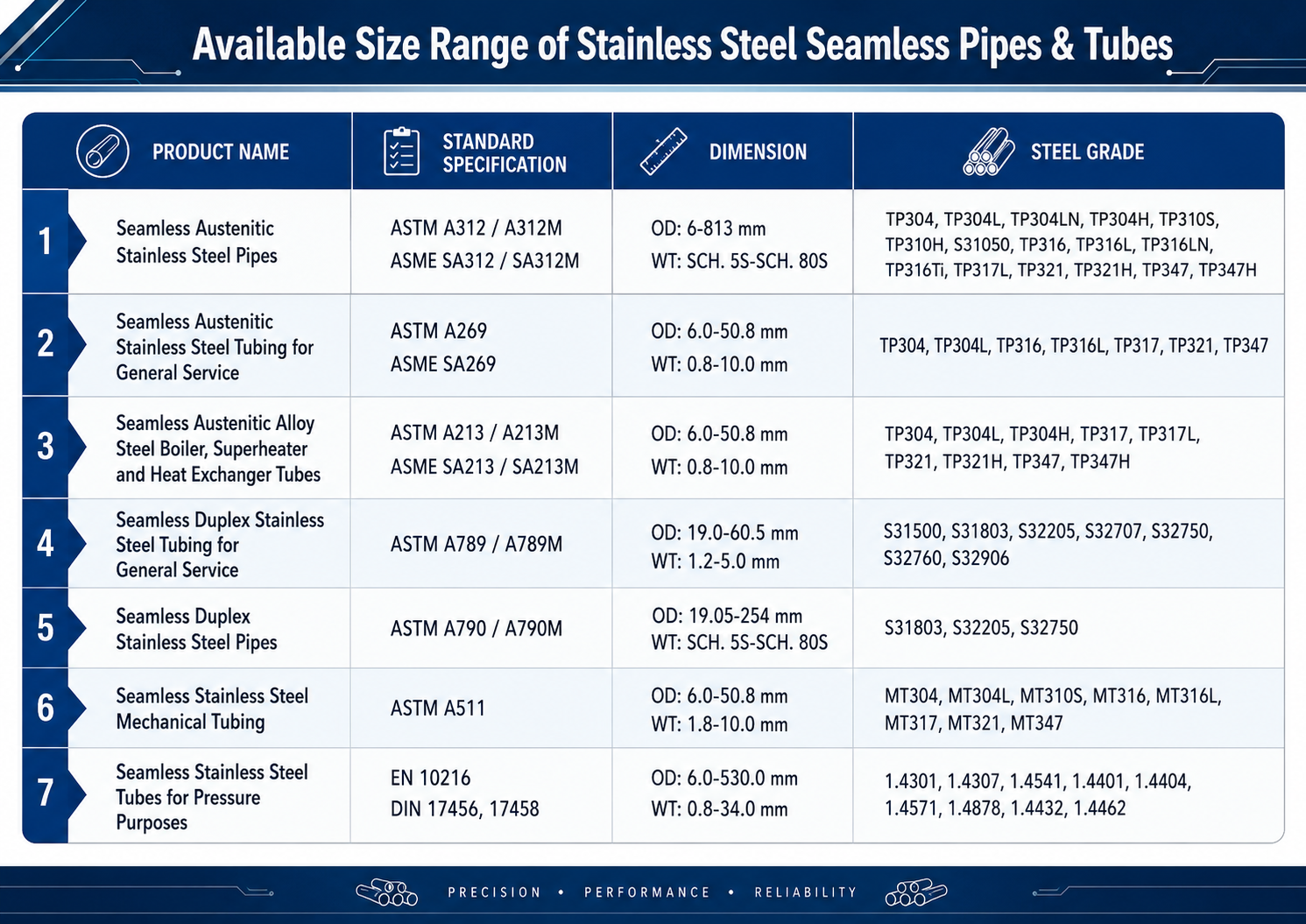
| Product | Standard |
| Size range | Grades |
| Austenitic stainless steel pipes | ASTM A312 / A312M, ASME SA312 / SA312M |
| OD 6 - 813 mm, WT SCH 5S - SCH 80S | TP304, TP304L, TP304LN, TP304H, TP310S, TP310H, S31050, TP316, TP316L, TP316LN, TP316Ti, TP317L, TP321, TP321H, TP347, TP347H Stainless steel tubing for general service |
| ASTM A269, ASME SA269 | OD 6.0 - 50.8 mm, WT 0.8 - 10.0 mm |
| TP304, TP304L, TP316, TP316L, TP317, TP321, TP347 Boiler, superheater and heat exchanger tubes | ASTM A213 / A213M, ASME SA213 / SA213M |
| Quoted to order | TP304, TP304L, TP304H, TP317, TP317L, TP321, TP321H, TP347, TP347H Duplex stainless steel tubing |
| ASTM A789 / A789M | OD 19.0 - 60.5 mm, WT 1.2 - 5.0 mm |
| S31500, S31803, S32205, S32707, S32750, S32760, S32906 Stainless steel mechanical tubing | ASTM A511 |
| Quoted to order | Confirmed against your enquiry Tubes for pressure purposes |
| DIN 17456, DIN 17458 | Quoted to order |
| Confirmed against your enquiry | |
Grade Selection
Five grades cover most orders, and the differences between them are about how much corrosion resistance the line needs rather than about quality. 201 is the economical austenitic choice for dry, mildly corrosive duty where cost leads. 304 is the general-purpose grade and the one most water, food and pharmaceutical circuits are built in where chlorides are low. 316 carries molybdenum and is the grade to specify once chlorides, salt spray or aggressive cleaning chemicals are in the picture. 430 is a ferritic grade chosen for mild service where its magnetic behaviour or thermal expansion is useful. 2205 duplex is picked when the line needs more strength and better chloride resistance than the austenitic grades deliver, and it is the usual answer for severe marine and chemical duty. A stainless steel pipe in 316 or 2205 is not automatically better for a dry, low-chloride line — the right grade is the one that survives the service with margin.
Water is where most grade questions actually land. Cold and hot water in a plant or municipal network is normally 304 or 316, and the deciding detail is the chloride level and the working temperature together, not either one on its own. A stainless steel water pipe sitting stagnant and warm is at more risk than the same pipe in constant flow, and a buried line has different exposure again from an indoor one. Send the water chemistry, the temperature and whether the run is buried, and we will say which grade and which wall we would put forward — including the case where a higher alloy is genuinely needed.
Storage & Site Handling
- Check every bundle before the delivery note is signed. Count the lengths, confirm the end caps are still in place, and read the heat number on each tag against the paperwork that travelled with the lot; photograph any staining, dents or ovality while the carrier is still on site.
- Store on timber dunnage laid across firm ground, never directly on concrete or bare soil, and set the stacks with a slight fall so rainwater runs off instead of sitting inside the bottom lengths. Heavier walls go at the bottom of the stack, lighter walls on top.
- Keep the pipe under cover but ventilated. A tarpaulin that seals a bundle traps condensation against the surface and does more damage over a wet season than a roof that lets air move. End caps stay on until the length is actually being cut or fitted.
- Segregate by grade and heat number. A 304 bundle and a 316 bundle that get mixed on site cannot be separated later by eye, and the paperwork no longer matches the stack. Keep carbon steel offcuts, wire brushes and grinding discs used on carbon steel well away from it.
- Lift with slings or padded forklift forks, and support long lengths at two or three points so the wall does not take a permanent bend. Dragging a length across concrete picks up iron particles that rust in place and appear as brown staining weeks later.
- Cut with discs reserved for stainless, deburr the cut edge, and re-cap the open end the same shift. A stainless steel pipe left open in a trench overnight collects grit, groundwater and chloride-bearing runoff that then has to be flushed out before the line is closed up.
- Keep mortar, cement dust, bleach and chloride-based cleaners off the surface. Any brown discolouration is far cheaper to pickle and passivate while the pipe is still on the ground than to treat after the run is welded in place.
- If the pipe will sit for months, inspect the stacks on a fixed schedule, re-cover them and rotate stock so the oldest lengths leave first. Note on the bundle what arrived when, so nothing is left standing forgotten at the back of the yard.
Ordering and Delivery
- Put the whole specification in the enquiry. Grade, outside diameter, wall thickness, length, standard, quantity and any testing or documentation you need. Even experienced steel pipe manufacturers cannot price a line they cannot see, and a missing wall thickness is usually what sends a quotation back and forth.
- Wall thickness, either way. Send millimetres from the drawing or the schedule from the line design; if it was built around a schedule 80 steel pipe, quote the schedule with the OD and we will match it against the standard.
- Cut lengths. Send the finished cutting list with the enquiry so lengths are set before the pipe is packed, rather than trimmed on site.
- Testing and paperwork. Say up front which reports you need so they travel with the lot instead of arriving later.
- Packing. Ends are capped, bundles are wrapped and strapped, and smaller sizes travel in wooden cases. Export seaworthy packing is the default for sea freight, and container loading is planned around the length and bundle weight on the order.
- Marking. Tell us if the bundles need heat numbers, size marks or your own shipping marks applied, and we will build it into the packing.
- Quantity. Give the tonnage or the piece count you are working to and we will confirm what can be scheduled together.
- Lead time. Grade and size drive it — duplex and heavy wall take longer than standard 304 — so confirm the date with us before you commit to a delivery programme downstream.
- Shipping and payment. Tell us the port and the terms you work on and the quotation is built on that basis; payment terms are agreed with the quotation.
- Talk to us before the specification is fixed. As a stainless steel pipe supplier we would rather query an unclear wall thickness or a grade that does not suit the fluid now than have a container of the wrong pipe arrive. Send the enquiry and you will get a quotation, a packing proposal and a shipping plan back together.
Supply Chain & Delivery Assurance
Ruihuang Pipe Technology Co., Ltd. has been manufacturing since 2009 and has been listed on the Shanghai Stock Exchange since December 2019 (stock code 100868). Five brands, more than 30 branches and sales networks across China, and over a hundred projects delivered together with Chinese enterprises give us the reach to gather the categories we supply into one order and one container, pack for export, plan production around your peak season, and ship from Shanghai to Southeast Asia, the Middle East, South Asia and West Asia on terms you prefer.
FAQ
What does no-weld actually mean on this pipe?
Weld-free means the pipe is formed from a solid steel billet that is pierced and then hot rolled or cold drawn, so the wall is continuous around the full circumference and along the full length. There is no longitudinal weld, no weld bead on the bore and no heat-affected zone beside it. On a stainless steel weld-free pipe that matters because the wall is the pressure boundary: the metal is uniform, so there is no seam to blend, no weld toe to inspect and no hardness step for a corrosive fluid to attack first.
Should I give you the wall in millimetres or as a schedule?
Either works, as long as the outside diameter goes with it. A schedule is a shorthand for wall thickness at a given OD, so a schedule 80 steel pipe has a heavier wall than a lighter schedule at the same size. If your drawings are written in millimetres, send the millimetres; if the line was specified by schedule, send the schedule and the OD and we will match it. What we would rather avoid is a wall chosen because it happens to be the nearest size on the shelf — the wall is what carries the pressure.
Which grade should I use for a chloride-bearing or marine line?
316 is the usual starting point once chlorides are present: salt spray, brackish cooling water, chloride-bearing process streams, or cleaning chemicals left standing in the line. Duplex 2205 goes further on strength and chloride resistance and is what we would normally suggest for severe marine and chemical duty. A 304 line can still be right where the chloride level is low and the temperature is modest. Send the fluid analysis and the working temperature and we will confirm the grade rather than leave you to guess — a stainless steel pipe is only as good as the alloy matched to its service.
Which fittings match this pipe?
Butt-weld elbows, tees, reducers, caps and flanges are ordered by outside diameter and wall, so the fitting wall has to equal the pipe wall or the weld will step. We supply stainless steel pipe fittings in the matching grade and schedule alongside the pipe, which keeps the joint consistent and saves you chasing two suppliers for one spool. For threaded or flanged connections, tell us the end detail and we will match the pipe ends to it.
Can the pipe be used for water service?
Yes — water treatment, plant water distribution and process water are routine applications. Grade choice follows the water: 304 where chlorides are low, 316 where they are not, with the working temperature taken into account either way. A stainless steel water pipe also keeps a smooth bore that does not scale up the way steel does, so flow stays closer to the original design. If your project works to a formal potable-water approval, check that requirement against the documentation before the order is placed.
When is a tube with no weld seam the better choice over welded tube?
Welded tube is entirely serviceable for general, lower-pressure work. A steel pipe formed without a weld seam earns its price where the wall has to survive something more demanding: high internal pressure, high temperature, thermal cycling, heat exchanger and boiler duty, or a corrosive fluid that would find a weld seam first. If the line is buried at low pressure or carries water at ambient temperature, welded tube may well be the sensible buy — the decision should follow the service, not the other way round.
How should the pipe be stored and handled before installation?
Keep it in its bundles on timber dunnage, off the ground and under cover, with the end caps left on until the pipe is actually being fitted. Stainless is not maintenance-free in storage: standing water inside a bundle, chloride-rich dust or runoff, and contact with carbon steel offcuts or wire brushes are the usual causes of staining that then needs pickling. Lift with slings rather than chains, do not drag lengths across concrete, and keep cutting and grinding tools used on carbon steel away from it. If the pipe will sit on site for a long stretch, re-cover the stacks so water cannot pool inside.