Product Overview
Carbon steel welded pipe begins as steel strip rather than a solid billet. The strip is rolled into a round section and closed with a longitudinal weld that runs the full length of the pipe, and that construction is the reason the product suits buyers who need volume, steady dimensions and a price they can repeat on the next order.
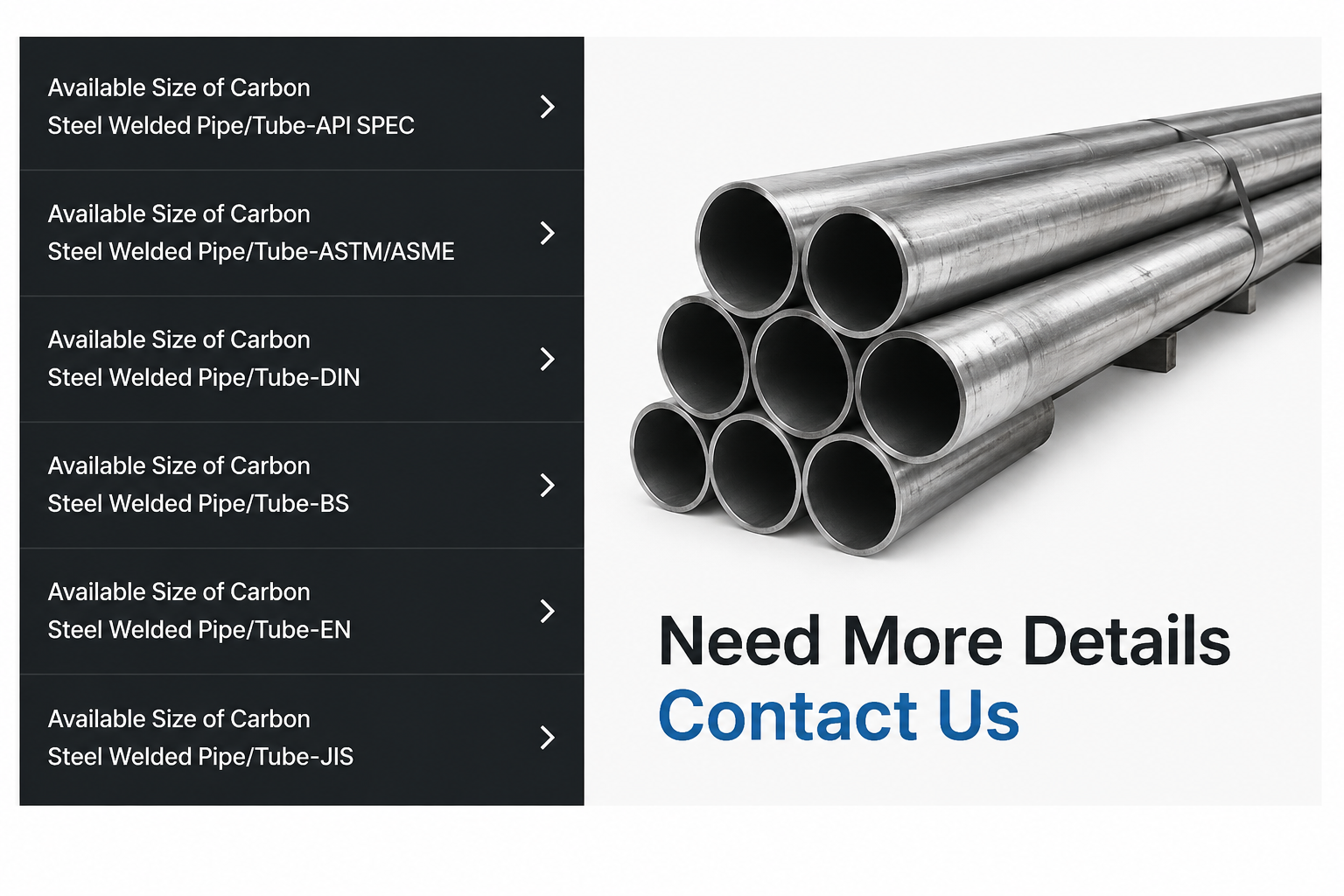
Grades are Q195, Q235 and Q345, produced to ASTM A53 and ASTM A106. The range runs from small-bore tube for frames and machinery up to large-diameter line pipe for mains and piling, so structural steel, steel water pipe and general plant piping can usually be covered in a single purchase.
Most buyers of carbon steel pipe are not chasing the highest available specification. They need a product that meets the design, arrives when promised and holds its price across repeat orders. Welded construction answers that: the coil-fed route keeps unit cost down, the wall stays uniform along the length, and the outside surface is smooth enough to paint, galvanize or coat without extra preparation.
As a steel pipe supplier we keep the offer narrow in the right way: one grade list, one coating list and one packing standard across the pipe and carbon steel pipe fittings you buy regularly, so a repeat order can be placed against the previous one instead of starting from zero.
Most steel pipe manufacturers hand over a size table and leave the rest to you. We would rather confirm the grade, the coating and the end finish on the quotation, so nothing has to be interpreted at the loading bay.
Production & Welding Process
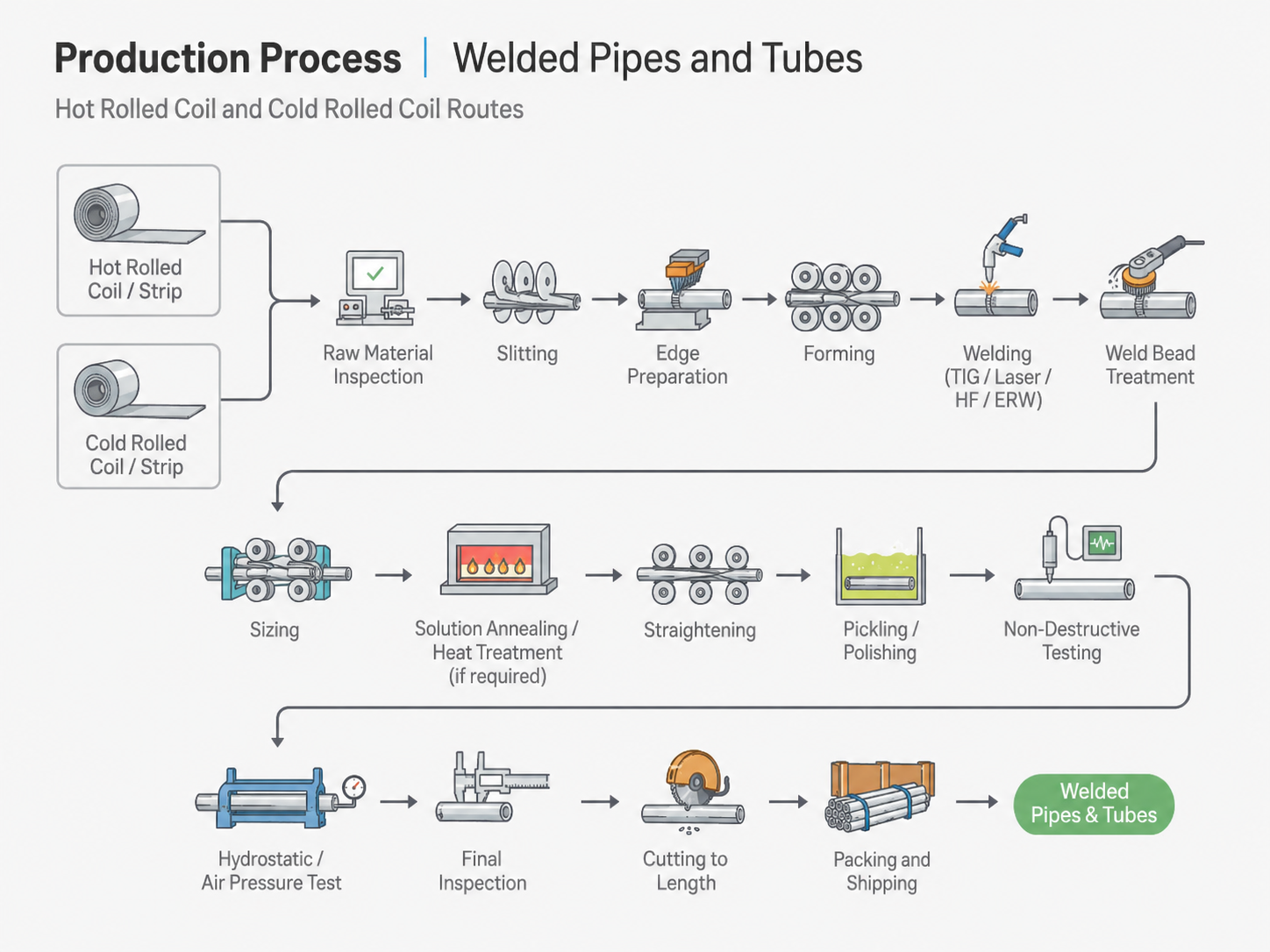
- Coil selection. Hot-rolled or cold-rolled steel strip is chosen by grade and thickness, and the coil width is matched to the finished diameter before the strip goes anywhere near the line.
- Slitting and edge preparation. The strip is cut to width and both edges are trimmed square. Square edges are what allow a straight, full-length seam instead of a wandering one.
- Forming. A series of rolls bends the flat strip into a round section without stretching the wall, so bore roundness and wall thickness stay even.
- Welding. A welded steel pipe is only as good as its seam. The seam is closed by ERW, high-frequency, TIG or laser welding depending on the line and the size being run; tell us the welding method your specification calls for and we will confirm it against the diameter and wall.
- Weld bead treatment. The inside and outside bead is trimmed or smoothed so the bore keeps its flow area and the outer face stays flat enough for coating and handling.
- Sizing. The pipe passes through sizing stands that bring outside diameter, roundness and straightness into tolerance before it is cut to length.
- Inspection and release. Dimensions, wall thickness and surface are checked before the bundle is closed, and any length that fails the check does not travel.
Key Features
- High mechanical strength from a low-carbon body. Q235 and Q345 carry structural loads in frames, piling and supports without forcing a heavier wall than the design needs, and the pipe still cuts and drills with ordinary shop tools.
- Welding behaviour fabricators already know. The steel chemistry stays simple and the weld zone is clean, so standard mild steel pipe procedures and consumables apply and site welds tie in without surprises.
- Pressure performance you can plan around. Wall thickness is held along the whole length of every welded steel pipe and the seam is a controlled, treated weld, so behaviour inside the design conditions of the standard stays consistent from one length to the next.
- A surface that takes a coating properly. The welded route leaves a smooth, even outside face, which is why the same pipe can be supplied black, varnished, galvanized or 3PE coated without extra surface work.
- A range wide enough to stock once. Small bore, medium structural sizes and large line pipe all come from the same grade list, so a distributor carries one family rather than three.
- One product for structure and fluid. The same carbon steel pipe works as a structural member and as a fluid carrier, which simplifies stock planning for anyone supplying both sides of a site.
- Cost that holds on repeat orders. Continuous coil-fed production wastes less material than batch routes, and that efficiency is what keeps the price steady when you reorder.
Surface Treatment Options
The coating decision separates two otherwise identical orders, because it decides how the pipe behaves in the ground, in the yard and on the finished structure. We supply five finishes, and each one answers a different exposure.
Black paint. The most economical option: a shop-applied black coating that slows light corrosion in transit and during short-term storage. It suits structural work, general plant piping and above-ground runs where appearance comes second, and it is the finish most buyers of black steel pipe ask for when the pipe will be painted again on site.
Varnish coating. A clear film that keeps the steel looking bare while holding off rust during shipping and indoor storage. Choose it when the pipe has to arrive clean and unpainted, for example when your own plant applies the final coating system.
Galvanized. A zinc coating for mild steel pipe that will sit outdoors, in humid air or in damp ground. Specify it when rust staining on the finished structure is unacceptable and when a galvanized steel pipe can take the place of a painted one that would otherwise need repainting.
3PE coating. A multi-layer polyethylene coating for buried lines in aggressive soil. It is the heaviest protection in the range and the one to choose for long-buried water and oil and gas lines, where the coating has to survive handling, backfill and years underground.
Anti-corrosion oil. A temporary film rather than a permanent finish. It keeps the surface clean through a long sea leg and is wiped or coated over at destination, which suits buyers who apply their own protective system after arrival.
Where two finishes both look plausible, match the choice to the exposure the pipe will actually see, then confirm the coating specification and the repair procedure with us before the order is released.
Service Applications
- Water transportation. Municipal and industrial water mains, pump-station pipework and distribution branches. A steel water pipe in these sizes is normally welded on site, and the coating follows from whether the run is buried or above ground.
- Construction projects. Piles, bracing, scaffold standards, handrails and frames, where Q235 or Q345 is cut and welded on site and strength counts for more than appearance; a galvanized steel pipe finish is common wherever the member stays exposed to weather.
- Oil and gas transport. Gathering lines, plant piping and general hydrocarbon transfer at moderate duty, using welded steel pipe in the grades and walls the line design calls for.
- Structural engineering. Trusses, columns and machine bases that need a stiff, weldable section in long lengths and a cost per metre that can be planned before the tender goes in.
- Machinery manufacturing. Conveyor frames, guards and equipment skids that are cut, drilled and welded in the workshop, where a round bore and consistent wall save setup time on every unit.
- Fire fighting systems. Fire mains, hydrant branches and sprinkler headers, with the coating matched to whether the pipe runs buried, inside a riser or exposed on a plant deck.
Specifications
| Property | Value |
|---|
| Product type | Welded carbon steel pipe, longitudinal seam |
| Steel grades | Q195, Q235, Q345 |
| Standards | ASTM A53, ASTM A106 |
| Nominal outside diameter | 21.3 - 3620 mm |
| Wall thickness | 1.5 - 60 mm |
| Surface treatments | Black paint, varnish, galvanized, 3PE coating, anti-corrosion oil |
| Typical service | Water transport, oil and gas, structural work, machinery, fire fighting |
| Product code | CS2605209 |
Pipe Ends, Fittings & Installation
- Decide how the line will be joined. Plain-end pipe is welded on site; mechanical couplings or flanged joints suit lines that will be opened later. Tell us which method your crew uses and we will confirm the end preparation available in your size.
- Order the fittings with the pipe. Elbows, tees, reducers, caps and flanges in carbon steel pipe fittings are made to the same outside diameter and wall as the pipe, and buying them together keeps the whole run to one tolerance and one shipment.
- Align before you weld. Support the pipe on dunnage or stands, keep the root gap even around the circumference and tack in several places before running the full pass. On long runs, work from a fixed datum so the line stays straight.
- Weld with a procedure suited to the grade. Q195, Q235 and Q345 all weld with standard low-carbon consumables under a qualified procedure; heavier walls need a balanced sequence of passes to keep distortion down.
- Test and touch up. Pressure-test the completed line before backfilling or commissioning, then repair the coating at the weld and at any handling marks so the corrosion protection stays unbroken.
Packing, Ordering & Delivery
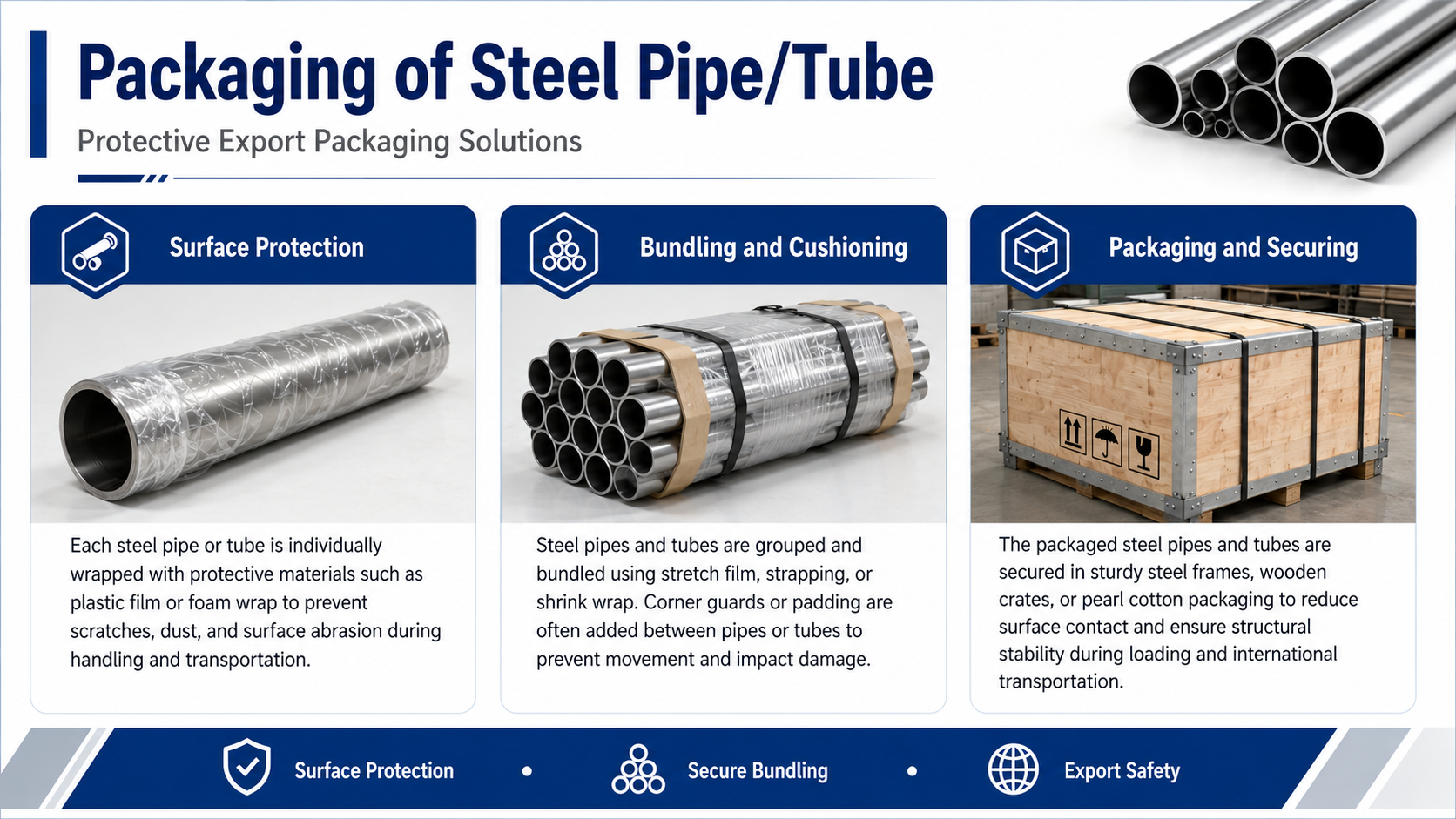
Packing is built around one risk: carbon steel pipe is heavy, it travels a long way, and every knock shows up later as a bare patch that rusts. Each length is wrapped in plastic film or foam wrap against dust and abrasion, bundles are closed with strapping and stretch film, and corner guards or padding sit between the pipes so they cannot rub or shift in the container. Larger orders travel in wooden cases or crates, and pallets are fumigated to clear import inspection.
The protective film matters most on black steel pipe and varnished pipe, where a rubbing strap can leave a bright mark before the coating has fully cured. Coated pipe keeps its wrap until unloading, and every bundle is checked against the packing list so size and finish can be verified on arrival.
As a steel pipe supplier we quote from your specification rather than from a fixed catalogue page: grade, outside diameter, wall thickness, length, coating and end finish all affect the price, so send them together with your destination port. Your sales contact will then confirm the quantity, the price basis, the production schedule and the payment terms that apply to your order before anything is released to the line.
If a project needs inspection records or material certificates, mention it at quotation stage so the documents can be issued with the shipment rather than chased afterwards. For anything that is still unclear, including a grade substitution or a mixed order of pipe and fittings, write to our sales team and we will answer with the actual specification for your size.
Supply Chain & Delivery Assurance
Ruihuang Pipe Technology Co., Ltd. has been manufacturing since 2009 and has been listed on the Shanghai Stock Exchange since December 2019 (stock code 100868). Five brands, more than 30 branches and sales networks across China, and over a hundred projects delivered together with Chinese enterprises give us the reach to gather the categories we supply into one order and one container, pack for export, plan production around your peak season, and ship from Shanghai to Southeast Asia, the Middle East, South Asia and West Asia on terms you prefer.
FAQ
When should I choose welded pipe rather than pipe without a weld?
For water lines, structural work, fire mains and general transport at moderate duty, welded pipe covers the requirement at the lowest cost per metre: one longitudinal seam, a uniform wall and a clean bore. Pipe with no seam is specified where the line runs at high pressure or high temperature, or where a project code demands a product with no seam at all. We supply both, so describe the duty and we will confirm which one the design should use.
What do the Q195, Q235 and Q345 grades change for my project?
They are low-carbon grades of increasing strength. Q195 is the softest and is used for light forming and general work, Q235 is the everyday structural and general-purpose grade, and Q345 carries heavier loads in frames, piles and supports. All three weld with familiar mild steel pipe procedures, so the choice comes down to what the member or line has to carry. Tell us the application and we will confirm the grade; ASTM A53 and ASTM A106 are available where an international designation is needed on the drawings.
Can this pipe be used for fire fighting mains and water lines?
Yes. Fire fighting systems and water transportation are two of the main uses for carbon steel welded pipe, and both are usually specified with a coating: black paint or varnish above ground, 3PE where the line is buried. Check the local code that governs the fire main before ordering, and tell us the exposure so the coating matches it. A steel water pipe that stays dry inside a building needs far less protection than one buried in wet ground.
Do you also supply carbon steel pipe fittings with the pipe?
Yes. Elbows, tees, reducers, caps and flanges in carbon steel pipe fittings are available to match the outside diameter and wall you order. Buying them together keeps the whole run to one tolerance, one packing list and one shipment, which matters most on project orders where a missing reducer can hold up a crew.
What should we do if the coating is damaged during unloading?
Note it on the delivery documents first, then repair before the pipe goes into store. Small marks on black steel pipe clean up with a wire brush and a compatible paint, a galvanized steel pipe needs a zinc-rich repair product, and 3PE needs the repair method we recommend for that coating. Send us photographs of the damage and we will confirm the right material and method for your site.